
Explainer · Public health
What does wet-bulb temperature tell us about dangerous heat?
Wet-bulb temperature describes the cooling possible through evaporation under specified conditions. It helps explain humid heat, but it is not a universal boundary between safety and danger.
SharedMorrow Editorial · Last reviewed 2026-10-05
Why humidity changes the experience
The body produces heat through metabolism and activity. It exchanges heat with its surroundings and can cool through evaporation of sweat. When the surrounding air is already moist, evaporation becomes less effective. Sweat that remains on the skin or drips away has not provided the same cooling as sweat that evaporates.
A wet-bulb measurement uses a wetted sensor with airflow. Evaporation cools it below the ordinary air temperature unless the air is saturated. The resulting temperature reflects both heat and moisture. It is a property of the measurement environment, not a direct reading of someone's body temperature.
Similar names, different tools
| Measure | What to remember |
|---|---|
| Air temperature | Does not by itself include humidity, sun or workload |
| Heat index | Combines temperature and humidity under specified assumptions, commonly shaded conditions |
| Wet-bulb temperature | Describes evaporative cooling under the measurement conditions |
| Wet Bulb Globe Temperature, WBGT | A heat-stress index that also accounts for factors such as radiant heat; it is not plain wet-bulb temperature |
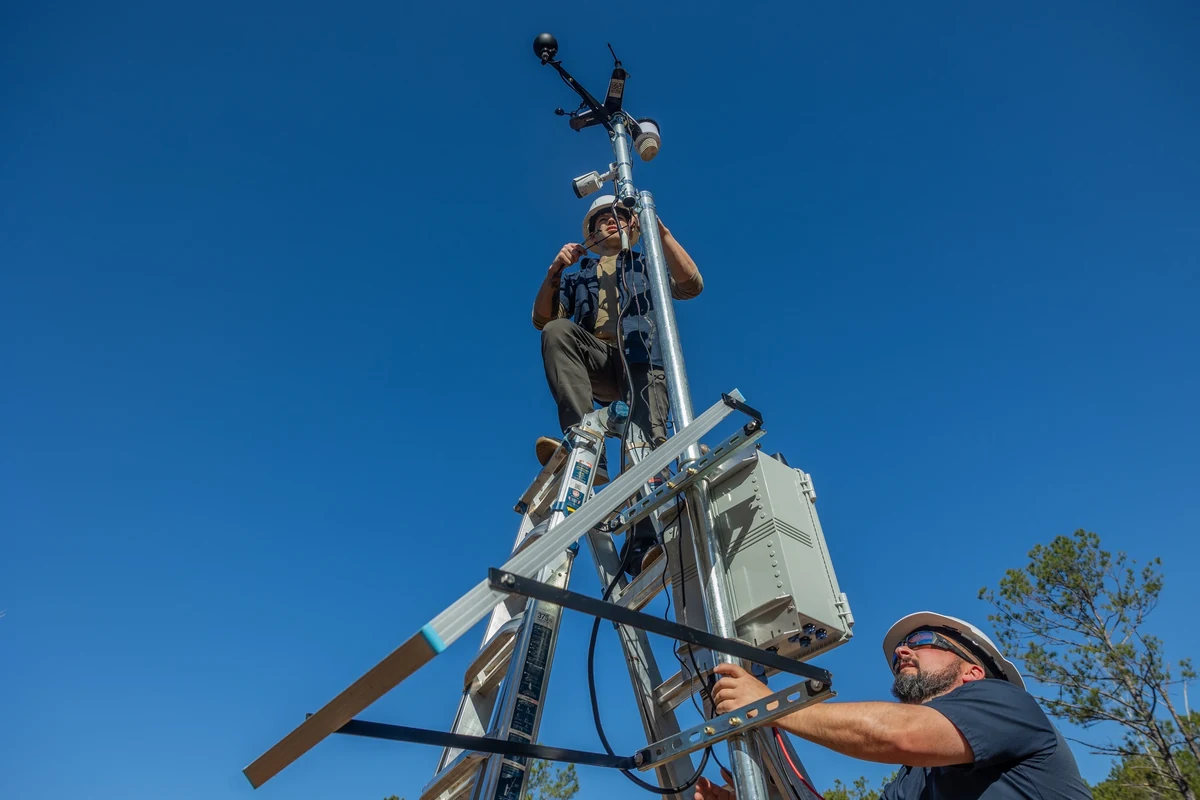
The monitoring equipment in the photograph supports local heat-risk assessment. The source describes WBGT-related monitoring. The photograph is not a demonstration of a single wet-bulb threshold or a medical assessment of the people shown.
Why a single threshold is misleading
Popular explanations sometimes present one wet-bulb value as a line below which everyone is safe. Real heat strain depends on duration, exertion, clothing, sun, wind, age, health and access to cooling. Dangerous conditions can occur below a theoretical upper limit discussed in scientific work.
Even in the same town, working on a sunlit roof and resting in a shaded ventilated room are different exposures. An index is useful when its assumptions match the decision. Taking a number from one setting and applying it to every person can create false reassurance.
A more useful way to read a heat forecast
- Check which index is being reported and whether it describes shade, sun or a workplace-specific assessment.
- Look at duration and overnight temperatures, not only the day's peak.
- Consider the actual setting: indoor heat, physical work, clothing and access to a cooler place.
- Follow local heat alerts and occupational or public-health advice appropriate to the people involved.
This is a planning framework, not an individual medical clearance. A weather app cannot establish that someone is safe to continue strenuous activity. Symptoms and deteriorating conditions need attention even if the displayed number is below a remembered threshold.
Why this matters in a warming climate
Rising temperatures increase the background on which humid and dry heat episodes occur. Humidity trends differ by place, and heat stress is not identical to air temperature. Cities can add warm nights, while unreliable electricity can limit cooling during the very period it is needed most.
The practical issue is often cumulative exposure. A hot workplace, a hot journey home and an uncooled bedroom can leave little relief. Community planning needs to consider where people can actually cool down and whether those options remain available during outages.
Common questions
Can dry heat also be dangerous? Yes. Efficient evaporation is not unlimited, and very hot conditions, dehydration and exertion can still cause serious strain.
Does high humidity mean no sweat evaporates? Not necessarily. Evaporation depends on the moisture difference near the skin and airflow, among other factors; it becomes less effective as conditions become more humid.
Should I compare a WBGT forecast directly with a wet-bulb threshold from an article? No. They are different measures. Use the interpretation supplied with the relevant local guidance, and seek urgent help for suspected heat illness rather than trying to diagnose it from an index.