
Explainer · Earthquakes & tsunamis
Earthquake early warning is not earthquake prediction
Early warning detects an earthquake that has already begun and tries to send information before stronger shaking reaches a location. Prediction would specify a future earthquake before it starts. The distinction explains both the value and the limits of an alert.
SharedMorrow Editorial · Last reviewed 2026-10-05
The earthquake has already started
When a fault ruptures, seismic waves travel outward. The first-arriving P waves can be detected by instruments before the more damaging motion arrives farther away. Data processing and communications can move information faster than seismic shaking travels through the ground.
An early-warning system uses those first observations to estimate the event and expected shaking. It then updates the estimate as more observations arrive. It is a race against travel time, not a way to know the future. Near the rupture, there may be little or no useful warning before shaking begins.
What each kind of statement means
| Statement | What it can legitimately claim |
|---|---|
| Long-term hazard estimate | The likelihood of specified shaking over a stated period and region |
| Aftershock forecast | Probabilities for earthquakes following an event, with uncertainty |
| Early-warning alert | A detected event may produce shaking at the recipient's location |
| Exact earthquake prediction | A specified future time, place and magnitude; no reliable general method currently exists |
Animal behaviour, an unusual cloud or a single small earthquake is not a validated general method for making that last claim. A prediction that omits a clear time, place and size cannot be meaningfully tested in the same way as a specific scientific forecast.
Seconds are used by several steps
- Sensors detect motion and transmit observations.
- The system estimates the developing earthquake and likely shaking.
- Alert-delivery channels carry a message to devices or automated systems.
- The recipient needs time to recognise the alert and act.
The available time depends on distance, rupture development and communication delays. It is not a fixed number that every person receives. A phone setting, network problem or location outside the service area can also affect delivery. Never assume that silence means no earthquake is occurring.
What the Ridgecrest example helps explain
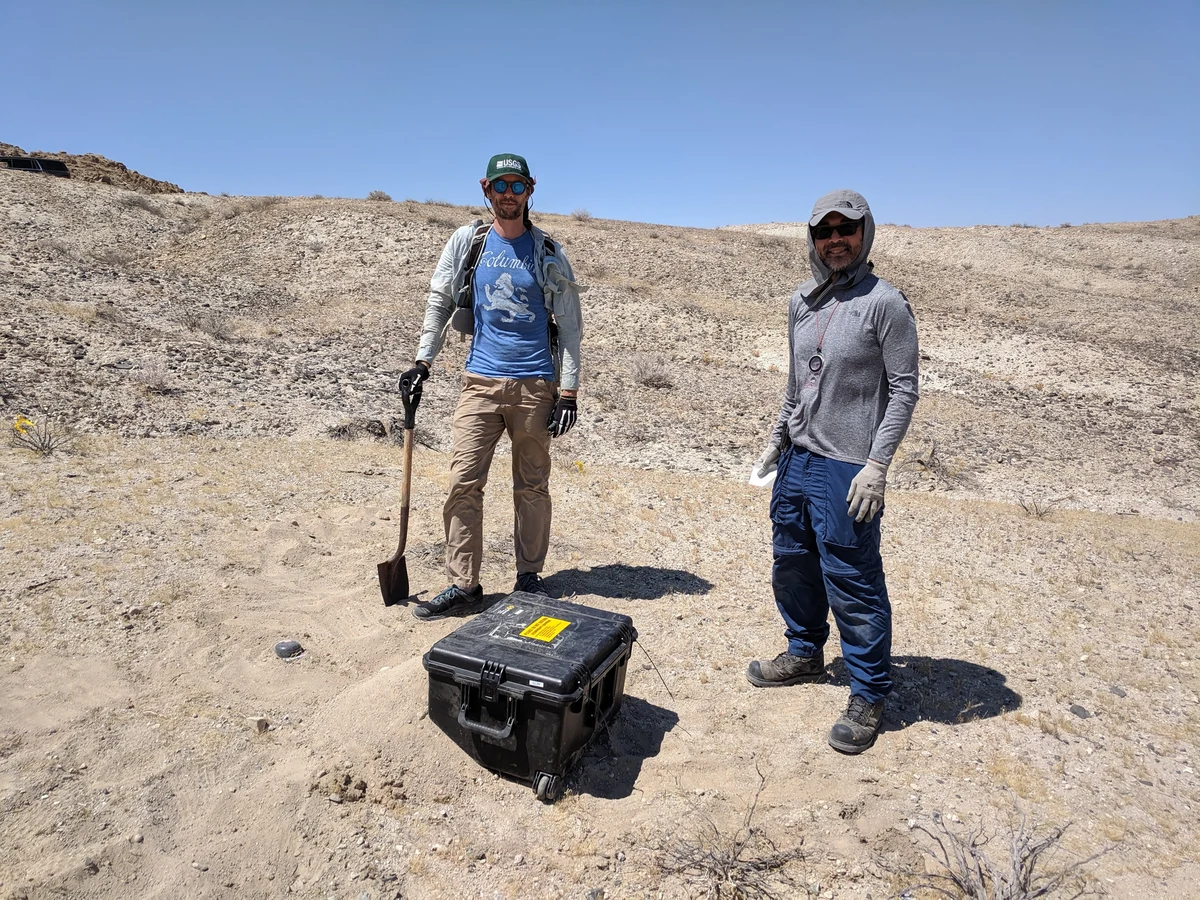
The photograph shows USGS scientists installing equipment to record aftershocks of the 2019 Ridgecrest earthquakes. It illustrates how observing networks obtain evidence; it is not a photograph of an earthquake being predicted. The sequence also reminds us that earthquake estimates develop as measurements are processed.
ShakeAlert on the U.S. West Coast detects earthquakes and supplies information to alert-delivery partners. Systems in other countries have their own coverage, thresholds and instructions. An article describing one system does not establish that a reader's location or phone is supported.
Why alerts can change
The first estimate is based on an incomplete part of a rupture. As it grows, the estimated magnitude and affected area may change. Delivery thresholds also involve trade-offs: warning for weaker expected shaking may reach more people, while higher thresholds can omit some useful alerts.
These limitations should be explained openly. An early warning is an estimate designed to support rapid action, not a guarantee that the shaking will match a precise value. Evaluation needs records of real events, delivery and observed motion, rather than one anecdote about a phone.
Questions to settle before an earthquake
Should I wait for an alert if I feel shaking? No. Follow the protective action recommended for your setting immediately; a nearby event may outrun the alert.
Does an aftershock forecast name the next earthquake's exact time? No. It gives probabilities over a period and area.
Can early warning prevent a building from collapsing? The alert does not strengthen a building. Construction, retrofitting and land-use decisions address different parts of risk. Warning can support protective action and some automated responses, but it cannot replace those measures.