
Explainer · Wildfire & environment
Why can a burned hillside produce a debris flow?
A wildfire can leave a slope less able to absorb and slow rainfall. Intense runoff can then gather soil, rocks and woody material into a fast-moving flow, sometimes before much rain has fallen nearby.
SharedMorrow Editorial · Last reviewed 2026-10-05
The landscape has changed
Vegetation and litter normally intercept rain and help protect the soil surface. Fire can remove that cover, alter soil properties and leave loose material exposed. The degree of change varies with burn severity, soil, terrain and weather. Not every burned slope becomes water-repellent, and water repellency is not the only mechanism that matters.
During intense rain, runoff can erode channels and entrain sediment. As water and debris combine, the flow can behave very differently from clear-water flooding. Large rocks, logs and dense sediment give it destructive force. A small drainage can concentrate material from slopes that are difficult to see from a road or house below.
From rain to a channelised flow
- Rain falls on a recently altered slope, sometimes at a rate that exceeds infiltration.
- Surface runoff gathers loose sediment and converges into channels.
- The mixture can grow by eroding more material along its route.
- At the foot of a canyon it can spread, block crossings or follow routes beyond the ordinary stream channel.
This sequence can develop quickly. A household below the burn area may receive little local rain while intense rainfall higher in the catchment creates the threat. Looking out of the window is not a substitute for the warning covering the upstream terrain.
Similar hazards, different mechanisms
| Hazard | A useful distinction |
|---|---|
| Clear-water flood | Mainly water, although it can still carry dangerous debris |
| Debris flow | A moving mixture with substantial sediment and larger material |
| Landslide | Downslope movement of soil or rock; may begin by a different failure mechanism |
| Post-fire erosion | A broader process that does not always become a debris flow |
Everyday language often calls all of these “mudslides.” That can obscure what a warning means. The expected speed, route and protective actions depend on the actual process and local guidance.
Montecito shows the danger after the flames
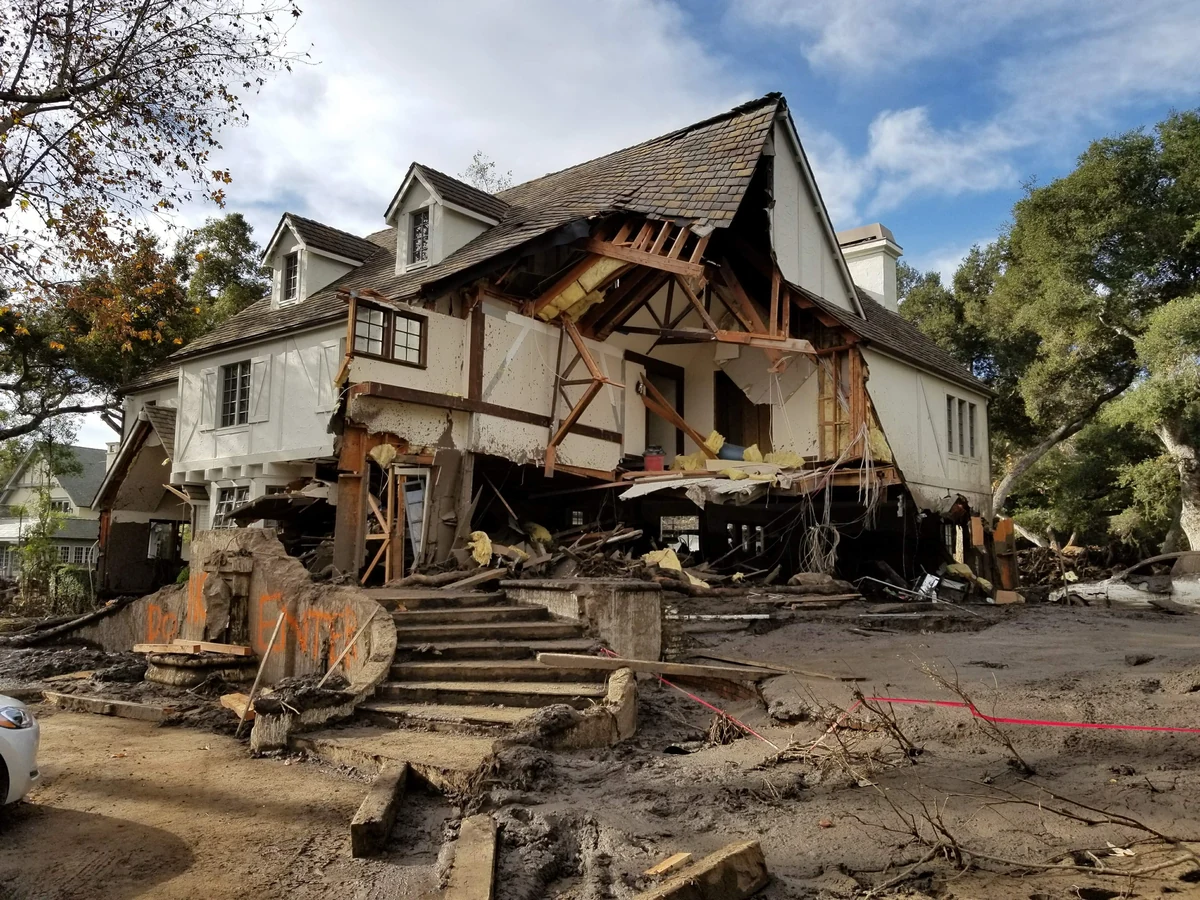
On 9 January 2018, debris flows affected the Montecito area following the 2017 Thomas Fire. The USGS photograph shows a damaged home and large deposited material. The event is a concrete example of a fire changing the conditions for a later rainfall hazard.
It does not establish that all burned communities face the same rainfall threshold. A post-fire assessment must consider the specific burn, slopes, drainage and expected rainfall. Copying a number from another catchment can produce either unnecessary alarm or false reassurance.
Recovery is not a single date
Vegetation regrowth, changes in soil and the removal or redistribution of loose material can reduce susceptibility over time, but the pace differs between places. A hillside looking greener does not by itself prove that downstream risk has returned to its earlier level. Several rainy seasons and local reassessments may matter.
Warning systems use rainfall observations and forecasts with hazard assessments. They still face uncertainty about exactly where and when a flow will begin. Because travel can be fast, evacuation decisions may need to precede the heaviest rain rather than wait for visible debris.
Questions to ask locally
Which upstream burn area drains toward this neighbourhood? Which roads cross the expected flow paths? Where are the official evacuation zones and rainfall-triggered warnings? These questions are more useful than asking whether the fire itself is fully out.
Can a barrier or a cleaned channel make a home safe? Such measures may reduce some risk, but their design capacity, maintenance and the event size matter. They are not universal guarantees.
Can I drive through a shallow-looking flow? Do not use apparent depth to judge safety. Moving debris can hide the road, damage crossings and change rapidly. Follow road closures and local emergency instructions.