
Explainer · Storms & floods
What is storm surge, and why can it be so dangerous?
Storm surge is an abnormal rise of sea level driven by a storm, above the expected astronomical tide. It can flood land even where the rainfall has not been exceptional.
SharedMorrow Editorial · Last reviewed 2026-10-05
Wind moves more than the waves
Strong winds push water toward the coast. The water cannot always disperse quickly enough, so it accumulates. Low atmospheric pressure also contributes, but wind is usually the dominant driver of a large tropical-cyclone surge. The shape of the coastline, the depth of the seabed and the storm's size and track all influence the result.
This is different from the short waves breaking on a beach. Those waves ride on the raised water level and can reach farther inland or damage structures above the still-water flood level. A modest-looking change in the background level can therefore expose places that ordinary surf does not reach.
Read the terms separately
| Term | Meaning |
|---|---|
| Astronomical tide | The predictable rise and fall associated mainly with the Moon and Sun |
| Storm surge | The storm-driven departure from the predicted tide |
| Storm tide | The combined water level from the tide and surge |
| Wave action | Additional, rapidly changing effects of waves on top of that water level |
When a forecast says “inundation above ground,” it is answering a different question from a water level measured relative to a tidal datum. Confusing the reference level can lead to a dangerously wrong mental picture of how much water may cover a street.
Why neighbouring coasts can fare differently
- Onshore winds and the storm's track push water toward some stretches of coast more than others.
- A shallow shelf or a narrowing bay can favour water accumulation.
- The timing relative to the tide changes the combined water level.
- Rivers, rainfall and drainage interact with the coastal water level, sometimes restricting the escape of inland water.
These effects are not captured by the hurricane category alone. That category describes sustained wind speed. A large storm can affect a long coastline, and a locally damaging surge can occur outside the place with the strongest winds. A forecast cone is not a map of the full flood hazard.
What Sandy helps explain
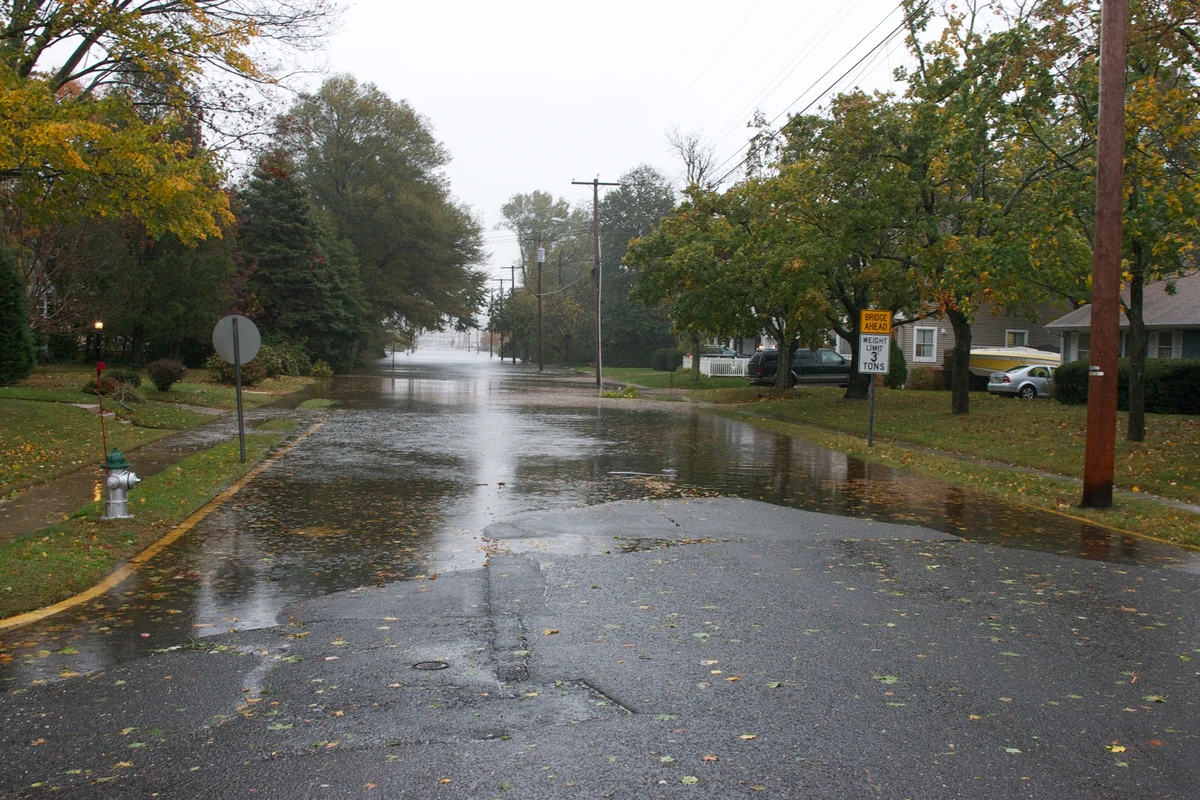
The 2012 Sandy photograph shows early coastal flooding in Brielle, New Jersey. It is a historical observation, not a prediction for another community. Sandy is a useful reminder that the storm's changing meteorological label did not remove the coastal flood threat. People need the local hazard forecast, not reassurance from a name or category in isolation.
Coastal flood maps also require context. Terrain and drainage vary across short distances. A property can be outside a visibly exposed beach area yet connected to tidal water through a bay or channel. Distance from the open ocean is not a reliable substitute for a local inundation map.
What warming changes
Rising mean sea level raises the starting level on which tides, surge and waves act. The same storm-driven departure can then reach higher ground-relative levels. Changes in storms themselves are a separate part of the problem. It is useful to separate the baseline change from the storm dynamics instead of attributing every difference to one factor.
Forecast uncertainty remains in track, wind field and timing. That uncertainty is a reason to use the full warning information and evacuation zone, not to wait until the most severe outcome becomes certain. Access roads may flood before a home does.
Common questions
Is a tsunami a storm surge? No. Tsunamis usually begin with a rapid displacement of water, such as from seafloor movement, rather than sustained storm winds.
Can floodwater arrive before landfall? Yes. Surge and waves can affect the coast before the storm centre arrives.
Does a lower wind category mean it is safe to stay? No. Follow the applicable local evacuation instruction and coastal flood warning. Wind classification does not establish safety from water.
Watch the official explanation
Hurricane Storm Surge · English video · NOAA Ocean Today